When diesel gets more expensive, every unnecessary kilogram deserves another look.
Fuel has always been one of the biggest costs facing UK transport operators, but the pressure has become particularly difficult to ignore in 2026. Rising diesel prices, alongside higher insurance, employment and general vehicle operating costs, are putting margins under further strain.
Fleet managers cannot control the price at the pump. They can, however, look closely at the equipment being pulled behind the truck.
Trailer weight is only one part of the efficiency equation, but when a vehicle covers thousands of miles every year, small differences can start to matter. For operators running large fleets, those differences are multiplied across hundreds of trailers and thousands of journeys.
That raises an important question.
As operating costs rise, does lightweight trailer design become more valuable?
Why fuel costs are back under the spotlight
Fuel is an unavoidable cost of road transport.
Recent figures from Logistics UK show just how significant the pressure has become. Vehicle operating costs increased by more than 12% in the year to April 2026, driven in part by a 36% increase in diesel prices. Fuel represents around one third of the operating cost of an HGV.
The cost of filling a large HGV also reached around £1,000 a tank during periods of particularly high fuel prices earlier this year.
For an industry accustomed to working on tight margins, increases of that scale are difficult to absorb.
Operators have always looked for ways to improve fuel efficiency, from driver training and route planning to aerodynamics, tyres and newer tractor units.
Trailer specification deserves a place in that conversation too.
How trailer weight affects fleet efficiency
Every trailer has an unladen weight before the first pallet, parcel or piece of freight is loaded.
Reducing that weight creates more room within the legal gross vehicle weight for payload. Depending on the operation, it can also reduce the amount of weight being moved when the trailer is not running at maximum capacity.
Neither benefit should be overstated.
A lightweight trailer will not suddenly transform the economics of an inefficient transport operation. Fuel consumption depends on numerous factors, including route, speed, driving style, weather, tyres, aerodynamics, load and tractor specification.
Trailer weight is one of those factors.
That makes it worth considering.
A small improvement on one journey might appear insignificant. Repeat that journey throughout the year, then multiply it across a commercial vehicle fleet, and the conversation changes.
Fleet efficiency is often found in those incremental gains.
Why payload matters just as much as fuel
The conversation around lightweight trailers tends to focus heavily on fuel.
Payload can be equally important.
A lighter trailer gives an operator greater flexibility over the load it can carry while remaining within permitted weight limits. For payload-sensitive operations, reducing unladen trailer weight can allow more of the available gross vehicle weight to be used for revenue-generating freight.
That will not matter equally to every operator.
A fleet regularly cubing out before reaching its maximum permitted weight may see less benefit from additional payload capacity than an operation carrying dense or heavy goods.
This is why trailer specification needs to start with the job rather than the brochure.
Where does the trailer operate?
What does it carry?
How frequently is it fully loaded?
What are the typical journey lengths?
How long is the trailer expected to remain in the fleet?
Those questions provide a much better basis for choosing equipment than simply deciding that lighter must automatically mean better.
Lightweight engineering cannot come at the expense of strength
Removing weight from a trailer is relatively easy.
Removing weight while maintaining the strength, durability and reliability required for years of commercial use is much harder.
This is where engineering becomes important.
Commercial trailers have demanding working lives. They travel considerable distances, deal with repeated loading cycles and operate across everything from motorways to busy depots and distribution centres.
Saving weight has little value if the result is increased maintenance, more repairs or a shorter trailer lifespan.
The real challenge for any lightweight box van trailer is finding the right balance.
Weight matters.
Strength matters.
Longevity matters.
A successful lightweight design needs all three.
Whole-life costs change the calculation
Purchase price is easy to compare.
Whole-life cost requires more thought.
The true cost of a trailer develops over years of operation and includes far more than the figure on the original invoice.
Maintenance, repairs, trailer downtime, fuel consumption, parts availability, residual value and lifespan all contribute to trailer total cost of ownership.
This becomes particularly important when considering lightweight trailers.
Reducing unladen weight may provide operational benefits, but those benefits need to last. A trailer that saves weight on day one but requires additional repairs later in its life could quickly lose some of the financial advantage it was designed to provide.
Fleet managers therefore need to look beyond kilograms alone.
A better question might be:
What has been done to reduce weight, and what has been done to make sure the trailer remains fit for the job?
The answer says far more about the quality of lightweight engineering.
Why small efficiencies matter at fleet scale
The economics change considerably when hundreds of trailers are involved.
One small improvement multiplied across one trailer might not attract much attention.
Multiply it across 50, 100 or 200 trailers operating throughout the year and it becomes much more interesting.
Large fleet operators tend to look at equipment differently for this reason.
Trailer reliability affects workshop demand.
Parts availability affects downtime.
Unladen weight can affect payload flexibility.
Fuel efficiency affects operating costs.
Specification affects how easily equipment fits into existing operations.
No single factor makes the decision.
Collectively, they determine whether a fleet investment delivers the value expected from it.
This is one reason lightweight trailer design is increasingly relevant to larger logistics fleets. The potential value does not necessarily come from one dramatic saving. It comes from smaller operational improvements repeated across a large number of assets.
A new Lightweight Box Van built around that challenge
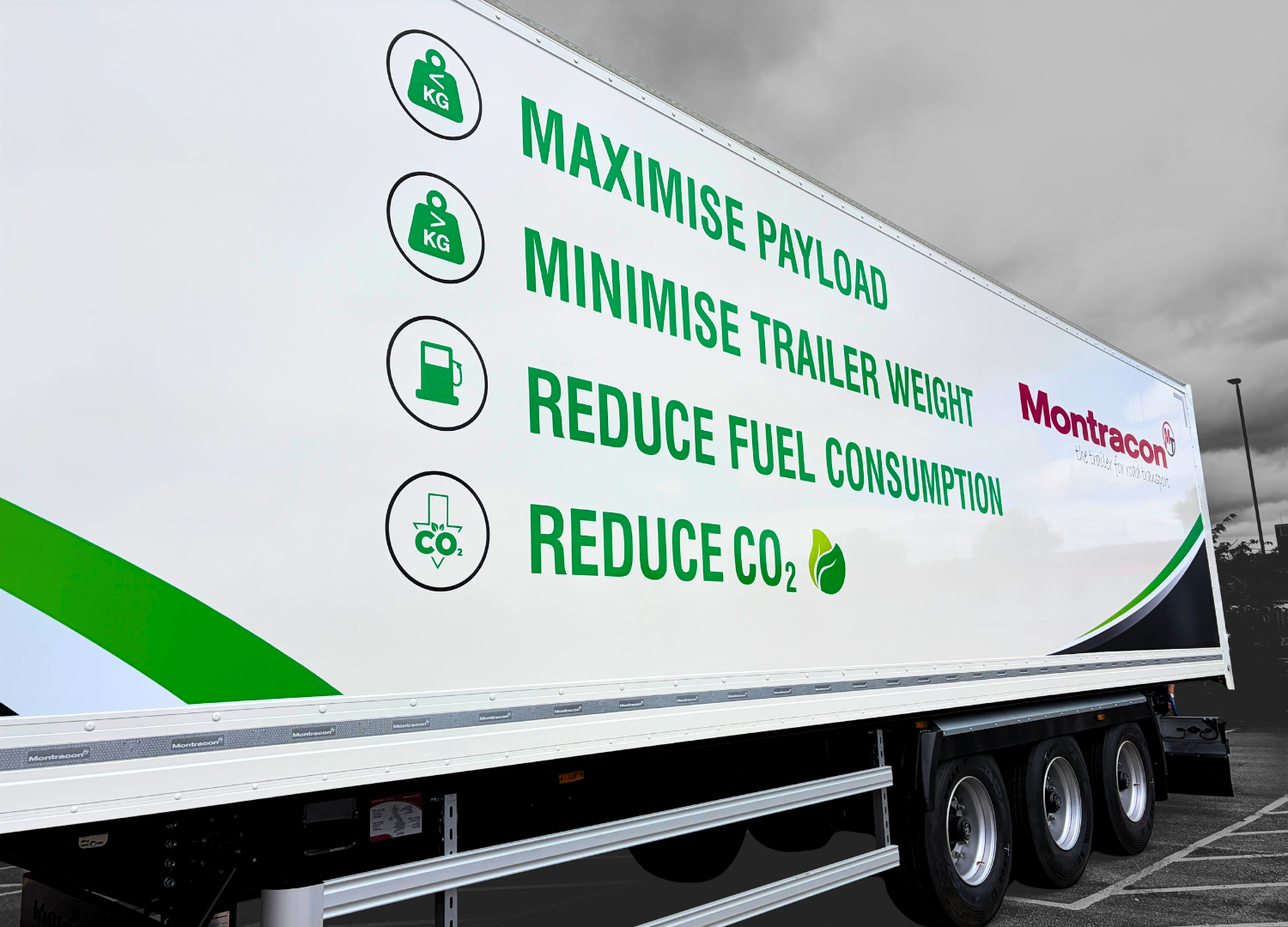
The new Montracon Lightweight Box Van was unveiled at Road Transport Expo 2026 after being developed around the changing requirements of fleet operators.
Its purpose is straightforward: reduce trailer weight to help maximise payload while retaining the strength and durability expected from a working box van trailer.
That distinction matters.
Building a lightweight trailer should never become a race to remove as much material as possible. The aim is to engineer weight out intelligently, considering how the trailer will actually be used and the demands it will face throughout its working life.
Montracon’s wider manufacturing approach starts from bare steel at the Doncaster factory, with fabrication, painting, wiring, piping, axle installation and body build carried out in-house.
Having control over those stages gives the engineering and production teams the ability to consider weight, strength, repairability and manufacturing quality together rather than treating them as separate concerns.
What should fleet managers consider before choosing a lightweight trailer?
Weight should never be viewed in isolation.
Before specifying lightweight trailers, operators should consider the type of freight being carried, typical payloads, annual mileage, loading patterns and expected trailer lifespan.
Maintenance requirements deserve equal attention.
How easy will the trailer be to repair?
Are replacement parts readily available?
What warranty support is provided?
Can the manufacturer support the fleet throughout the trailer’s working life?
The answers become particularly important for larger fleets where unexpected trailer downtime can quickly create problems elsewhere in the operation.
The right lightweight trailer is not necessarily the lightest trailer available.
It is the one that provides the best balance between payload, weight, durability, reliability and whole-life costs for the work being carried out.
Trailer manufacturers have a role in reducing operating costs
A trailer manufacturer cannot control diesel prices.
Neither can it control insurance costs, wages or many of the other financial pressures facing UK hauliers.
Engineering can still make a contribution.
Reducing unnecessary trailer weight, improving repairability, considering whole-life durability and helping operators specify equipment around their actual work are practical areas where manufacturers can influence fleet efficiency.
None will solve rising operating costs on its own.
Collectively, these decisions can help operators get more from the assets already travelling thousands of miles every year.
That is where lightweight engineering becomes most interesting.
The discussion is no longer simply about making trailers lighter.
It is about making fleets work harder without asking operators to compromise on the reliability they depend on.
Does trailer weight matter more than ever?
For some operations, absolutely.
For others, factors such as load volume, durability, loading requirements or specialist specification may take priority.
There is no universal answer, which is exactly why good trailer specification matters.
What has changed is the environment in which those decisions are being made.
Fuel costs remain volatile. Vehicle operating costs have risen. Margins across road transport remain tight, while fleet managers are under constant pressure to improve productivity and control whole-life costs.
Every part of the combination deserves scrutiny in that environment.
The truck has received much of that attention for years.
The trailer deserves it too.
Montracon’s Lightweight Box Van is one response to that changing conversation, combining lower weight with the quality, strength and longevity expected from a commercial trailer built for demanding fleet use.
That is a question worth asking while every kilogram, every journey and every pound spent on fuel is under closer scrutiny.